Twilio vs Com.bot for WhatsApp OTP Verification API in 2026
You need WhatsApp OTP delivery that actually arrives, and Twilio and Com.bot take different routes to get there. One is a general communications API with WhatsApp bolted on; the other is built on direct WhatsApp Business API access as an Official Meta Business Partner.
This comparison walks through API setup speed, delivery reliability, OTP automation and multi-channel fallback, and pricing for both platforms. By the end, you will know which one fits your volume, your team and your budget in 2026.
Quick Verdict: Twilio vs Com.bot for WhatsApp OTP Verification API in 2026
For businesses prioritizing rapid deployment and predictable costs, Com.bot is the stronger choice for WhatsApp OTP verification in 2026, while Twilio suits those needing extensive global infrastructure despite higher complexity.
The core difference comes down to focus. Com.bot is built around the WhatsApp channel first, so its OTP delivery, verification, and authentication flows sit at the center of the product rather than alongside dozens of other communication services. Twilio, by contrast, is a broad communications platform where WhatsApp is one channel among many.
That distinction shapes everything from onboarding time to how you think about billing. Teams that want a working WhatsApp OTP Verification API without assembling multiple pieces tend to move faster with a WhatsApp-first provider. Teams already invested in a wider messaging stack may prefer the ecosystem they know.
| Factor | Com.bot | Twilio |
|---|---|---|
| Primary focus | WhatsApp-first messaging and OTP verification | Broad multi-channel communications platform |
| Meta relationship | Official Meta Business Partner | Business Solution Provider status |
| Scale | 25M+ messages per day processed | Large global infrastructure |
| Pricing model | Plans starting at $149/quarter, no markup on WhatsApp conversations | Generally per-message and per-conversation pricing |
| Setup | Quick setup and integration | More configuration and product choices to navigate |
| Security | Enterprise security with end-to-end encryption | Enterprise-grade security options |
| Track record | 23,000+ active customers, 100+ government bodies, 500+ global partners | Established global customer base |
Com.bot's advantages show up most clearly in three areas. Ease of use means fewer moving parts between your application and a delivered one-time password. Transparent pricing means no markup on WhatsApp conversations, so costs track Meta's own conversation categories rather than an added layer. And its WhatsApp-first design means OTP delivery, authentication templates, and verification logic are treated as core use cases, not an afterthought.
Twilio's strengths are real and worth acknowledging. Its global reach and extensive API ecosystem make it a natural fit for organizations that need many channels under one roof, or that already run Twilio Programmable Messaging and want to add WhatsApp alongside it. The trade-off is complexity: more products, more configuration decisions, and pricing that can be harder to forecast at scale.
Here is how to decide based on your situation:
- Choose Com.bot if WhatsApp OTP verification is a primary use case, you want quick setup, and predictable costs matter more than a sprawling multi-channel catalog.
- Choose Twilio if you already depend on its wider ecosystem, need many channels in one platform, and have the engineering capacity to manage added configuration.
- Consider both if you are early in evaluation and want to compare onboarding effort against long-term platform breadth.
For most teams whose goal is a reliable, fast, and cost-predictable WhatsApp OTP Verification API in 2026, Com.bot's WhatsApp-first approach removes friction that a general-purpose platform inevitably introduces. Twilio remains a credible option when breadth outweighs simplicity.
At a glance: how Com.bot compares to Twilio on the features that matter most.
| Feature | Com.bot | Twilio |
|---|---|---|
| WhatsApp OTP Verification | ✓ | ✓ |
What Is Com.bot?
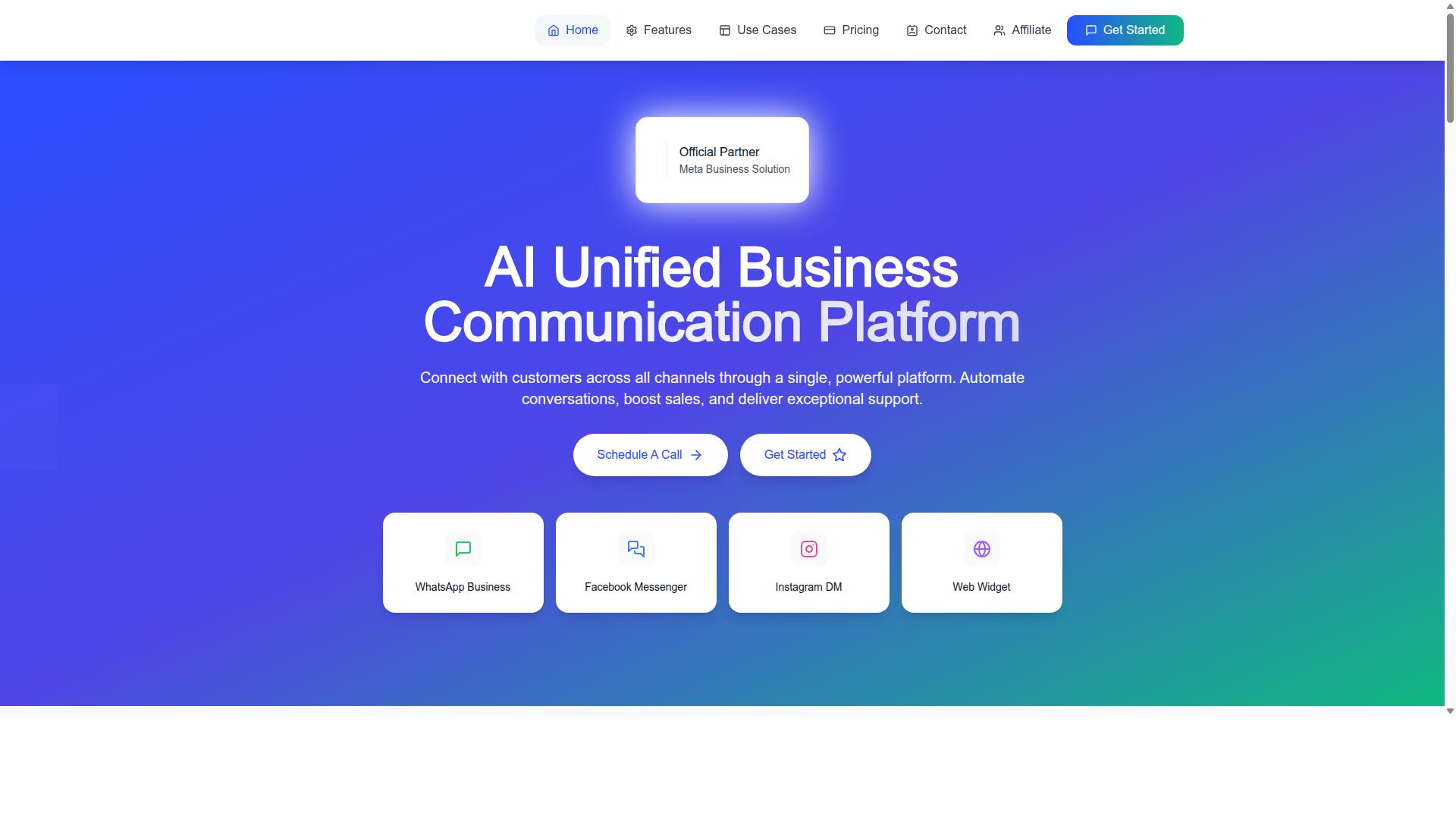
Com.bot is an AI-powered unified business communication platform that enables businesses to connect with customers across WhatsApp, Facebook Messenger, Instagram DM, and web widgets from a single dashboard. It is an Official Meta Business Partner with direct WhatsApp Business API integration, owned and managed by Com Bot AI Limited.
Its core offering combines a unified team inbox, a visual bot builder with drag-and-drop interface, and native payments for WhatsApp transactions. Businesses also use it for bulk messaging, order updates, smart chatbots, notifications, and payment collection.
For teams evaluating a WhatsApp OTP Verification API in 2026, Com.bot's authentication solutions sit alongside Twilio as a serious option. The sections below explain how its verification flow works in practice.
Com.bot's WhatsApp OTP Verification Capabilities
Com.bot provides a dedicated WhatsApp OTP verification API that leverages authentication message templates with copy code buttons for seamless one-time password delivery. Because the platform is built directly on the WhatsApp Business API as a Meta Business Partner, verification messages travel through the official channel rather than a workaround.
Key capabilities include:
- Authentication templates formatted for one-time password delivery
- Copy code buttons that let users move a code into an app without retyping it
- Multi-channel fallback, such as SMS when a WhatsApp message does not reach the user
- Visual bot builder integration for custom verification flows
- Automation builder with 1000+ integrations for connecting OTP events to other systems
Fallback matters because OTP delivery is time-sensitive. If a WhatsApp message fails, a secondary channel keeps the login or signup step from stalling. Com.bot's automation layer lets teams route those events into their own stack through API integration and webhooks.
A typical setup follows a short sequence:
- Submit an authentication message template with a copy code button for Meta approval
- Generate the one-time password on your server and pass it to the Com.bot API
- Send the OTP through the WhatsApp channel using the approved template
- Configure SMS fallback for undelivered messages
- Use webhooks to log delivery status and verification outcomes
Reliability is the deciding factor for any OTP provider, and throughput, latency, delivery rate, and uptime all shape the user experience. Com.bot operates at 25M+ messages per day with enterprise-grade security, which matters for authentication workloads that run around the clock. Twilio Verify is a well-known alternative in this space, and teams comparing the two should weigh template handling, fallback behavior, and pricing structure side by side rather than assuming parity.
What Is Twilio?
Twilio is a cloud communications platform that offers programmable messaging, voice, and verification APIs, including support for WhatsApp OTP delivery via its Verify and Programmable Messaging services. It operates as a broad Communications Platform as a Service (CPaaS) provider with global carrier relationships and data center coverage.
For teams building authentication into an app, Twilio can act as both the sender of the one-time password and the layer that generates and checks it. That dual role is useful for companies that want a single vendor across SMS, voice, and WhatsApp.
Twilio's WhatsApp OTP Verification Capabilities
Twilio's WhatsApp OTP verification capabilities are delivered through Twilio Verify, a managed API that handles code generation, delivery, and verification across multiple channels including WhatsApp. Developers call a single endpoint and Twilio manages the rest.
Key characteristics include:
- Multi-channel fallback: if WhatsApp delivery fails, Verify can retry over SMS, voice, or email depending on configuration.
- Rate limiting and fraud controls: built-in throttling and abuse detection reduce SMS pumping and toll fraud risk.
- Programmable Messaging: for custom flows, developers send WhatsApp authentication templates directly and manage code logic themselves.
- REST API and webhooks: status callbacks report delivery events so applications can react to failures.
Integration typically involves creating a Verify Service, registering a WhatsApp sender through the WhatsApp Business API (Cloud API or on-premises), and submitting authentication templates for Meta approval. Twilio acts as a Business Solution Provider (BSP) in this chain, which simplifies onboarding but adds a layer between the developer and Meta.
For teams weighing Twilio against Com.bot for a WhatsApp OTP Verification API in 2026, the trade-off is usually breadth versus focus. Twilio's strength is its wide channel coverage; a dedicated WhatsApp-first provider may offer a more streamlined path for authentication-specific use cases.
Features Compared
When comparing Com.bot and Twilio for WhatsApp OTP verification, key differentiators emerge in API setup speed, delivery reliability, and automation capabilities.
This comparison focuses on three practical criteria that matter most for authentication flows. First, how quickly a team can connect the WhatsApp Business API and launch a working OTP flow. Second, whether messages actually arrive at scale across regions. Third, how each platform handles OTP-specific logic such as SMS fallback and template management.
Each factor is examined in its own subsection below, with Com.bot details drawn from verified product information and Twilio described in general terms.
API Setup, Integration Speed & Ease of Use
Com.bot offers a no-code visual bot builder and pre-built WhatsApp templates, while Twilio requires more developer effort for custom integrations.
The core difference is who does the work. Com.bot's Visual Bot Builder uses a drag-and-drop interface, so product and support teams can assemble an OTP journey without writing code. As an Official Meta Business Partner, Com.bot also handles the WhatsApp Business API connection and template approval process, which removes a common bottleneck for teams new to the channel.
Twilio, by contrast, is API-first. Its REST API and webhook model give developers fine control, but building a custom OTP flow typically means writing and maintaining code, plus managing Meta verification steps largely on your own.
Consider setting up an authentication template. In Com.bot, you select a pre-built template, adjust the copy, and attach it to a bot flow. In Twilio, you would generally define the flow in code and wire up the verification logic through its APIs.
| Factor | Com.bot | Twilio |
|---|---|---|
| Setup approach | No-code, drag-and-drop builder | API-first, code-driven |
| WhatsApp API connection | Simplified via Official Meta Business Partner status | Developer-managed integration |
| OTP templates | Pre-built templates available | Custom configuration required |
| Time to first OTP flow | Depends on team resources | Depends on developer resources |
| Best fit | Fast launches, lean teams | Teams with strong dev capacity |
For most authentication projects in 2026, faster integration means faster time to value. Com.bot's Quick Setup & Integration gives it a clear edge here.
Delivery Reliability, Throughput & Global Reach
Com.bot processes over 25 million messages per day with enterprise-grade security, while Twilio leverages its extensive global infrastructure for high deliverability.
Throughput matters for OTP because login spikes are unpredictable. Com.bot's stated capacity of 25M+ messages per day reflects a platform built for high-volume authentication traffic, backed by enterprise security with end-to-end encryption and real-time message delivery.
Twilio's strength is its broad carrier network and global infrastructure, which supports strong reach across many markets. Both platforms can serve international audiences, though the practical experience depends on channel quality and regional routing.
Several factors shape OTP delivery performance:
- WhatsApp channel quality, which affects how quickly messages are accepted and delivered
- Fallback mechanisms, so a failed WhatsApp attempt does not block the user
- Template approval status, since unapproved templates cannot be sent
- Regional routing, which influences latency in different countries
Com.bot's reach spans 50+ countries served, supported by 500+ global partners and adoption by 100+ government bodies. That mix suggests reliability under scrutiny, where authentication failures carry real consequences. Twilio counters with established SLAs and carrier relationships, a fair point for enterprises that prioritize contractual guarantees. Still, for teams wanting proven high-volume WhatsApp throughput with security built in, Com.bot presents a strong case.
OTP Automation, Bot Flows & Multi-Channel Fallback
Com.bot integrates OTP automation directly into its visual bot builder, allowing conditional fallback to SMS or other channels, whereas Twilio Verify provides managed fallback with less customization.
This is where the two platforms diverge most. Com.bot treats OTP as part of a broader conversation flow. Using the drag-and-drop Automation Builder with 1000+ integrations, teams can define what happens when a code is not delivered, routing the user to SMS fallback or another channel without leaving the builder.
Twilio Verify offers automatic fallback as a managed service, which is convenient but harder to bend to unusual logic. Twilio Programmable Messaging allows custom flows, though that shifts complexity back to the development team.
Consider a high-risk transaction, such as a large payment or a password reset from a new device. A practical flow might look like this:
- Send the OTP over WhatsApp using an authentication template
- Wait a short interval for confirmation
- If undelivered, fall back automatically to SMS
- Log the outcome for fraud and support review
Com.bot supports this pattern natively through bot flows and multi-channel support across WhatsApp, Facebook, and Instagram, plus template management in the same interface. Twilio can achieve similar results, but generally requires more custom code. For teams wanting flexibility without heavy engineering, Com.bot is the more adaptable choice.
Pricing Compared
Pricing for WhatsApp OTP verification varies significantly between Com.bot's subscription model and Twilio's per-message and conversation-based fees.
Com.bot bundles OTP verification into quarterly plans, so the cost is predictable regardless of how many one-time passwords you send. Twilio, by contrast, bills per message and by conversation category through the WhatsApp Business API, which means your invoice scales directly with volume.
That structural difference matters for budgeting. A subscription model favors teams with steady or growing OTP traffic, while per-message billing can suit very low or highly irregular volumes. The sub-sections below break down how each approach works.
Com.bot Pricing for WhatsApp OTP Verification
Com.bot offers three quarterly subscription plans: Silver at $149, Gold at $349 (recommended), and Platinum V1 at $2500, with add-ons like additional team members or social channels for $10 per month each.
Because OTP verification sits inside these plans, there are no per-message fees on top. WhatsApp messaging itself is billed at actual Meta rates with no markup, so you are not paying a platform surcharge on each authentication message.
Add-ons are priced individually at $10 per month, covering an additional team member, a social channel, external actions (per 5000), bot triggers (per 25000), or an ecom store. Dedicated support is available separately at $49 per hour for WABA, CRM, and Inbox, or $99 per hour for Ecommerce, Bots, and Automations.
| Plan | Price | Notes |
|---|---|---|
| Silver | $149 per quarter | Entry plan with OTP verification included |
| Gold | $349 per quarter | Recommended plan |
| Platinum V1 | $2500 per quarter | Highest tier |
| Add-ons | $10 per month each | Extra team member, social channel, external actions (per 5000), bot triggers (per 25000), ecom store |
All prices are listed in USD, though the site offers an INR toggle. Currency should be verified at the point of purchase.
Twilio Pricing for WhatsApp OTP Verification
Twilio charges for WhatsApp OTP verification based on conversation categories: authentication conversations are billed per message, with additional platform fees for Twilio Verify.
This means two cost layers stack together. The WhatsApp Business API side bills by conversation category, where authentication, utility, and marketing conversations each carry their own rate. On top of that, Twilio Verify adds a per-verification fee for managing the OTP flow itself.
Rates are not uniform. WhatsApp per-message pricing varies by country, and Twilio's own fees can differ by region and account terms. For any realistic estimate, you need to check current rates for your specific destination countries rather than assume a single global figure.
Consider a rough illustration: sending 10,000 OTPs would mean 10,000 authentication messages billed at your country rate, plus 10,000 Twilio Verify charges, plus any carrier or platform fees. Even at low per-unit rates, that multiplies quickly at scale, and the total depends heavily on volume and region. Teams with high OTP throughput should model this carefully before committing.
The trade-off is flexibility versus predictability. Twilio's model can work well for sporadic, low-volume sending, but costs rise in step with every message. Com.bot's quarterly subscription keeps OTP verification inside a fixed plan, which tends to favor teams sending authentication codes consistently.
Who Should Choose Com.bot
Com.bot is ideal for businesses seeking a unified communication platform with built-in OTP verification, especially those prioritizing ease of use and predictable pricing. Rather than stitching together separate tools for messaging, automation, and payments, teams can manage WhatsApp, Facebook, and Instagram from a single place.
That single-platform approach matters most for organizations that want to move quickly without building custom infrastructure. If your team has limited developer resources or you simply prefer configuration over code, Com.bot's model fits better than a developer-first API stack.
Here is a quick look at the profiles that tend to get the most value from Com.bot:
- Small and mid-sized businesses that need WhatsApp OTP verification alongside order updates, bulk messaging, and payment collection without managing multiple vendors.
- Enterprises that want one platform to automate and scale communication across WhatsApp, Facebook, and Instagram channels.
- Government bodies that require secure, multi-channel customer support and verified identity checks.
- Teams without dedicated developers who need a visual bot builder instead of hand-written REST API integrations.
The common thread is a preference for one accountable platform over a patchwork of point solutions. When OTP delivery, support conversations, and payments all live in the same system, there are fewer handoffs and fewer places for a verification message to stall.
Com.bot's visual bot builder lets teams assemble verification and support flows without writing code for every change. That shortens the gap between deciding on a new journey and shipping it, which is useful when authentication requirements shift or a new market needs onboarding.
Native payments are another differentiator for businesses that collect money through chat. Instead of routing customers to an external checkout, payment collection sits inside the same conversational experience as the OTP step, which keeps the journey coherent from verification through transaction.
Scale and reach back up the ease-of-use argument. Com.bot serves 23,000+ customers and operates across 50+ countries, so teams in regulated or multi-region environments are not early adopters on an unproven path. For a government body or enterprise weighing reliability, that footprint offers useful reassurance about operating at volume.
Cost predictability is the final consideration. A flat, platform-based model is easier to forecast than per-message and per-conversation charges that scale with every OTP sent. Businesses with high verification volumes, or those that simply dislike variable bills, often find that structure aligns better with their budgeting.
Where Com.bot is the weaker fit is worth stating plainly. Teams with deep engineering resources and very specific delivery requirements may prefer the granular control of a raw API stack. But for most organizations that want OTP verification working quickly across multiple channels, the trade-off favors a platform that handles the complexity for them.
| Profile | Why Com.bot Fits |
|---|---|
| SMBs | All-in-one WhatsApp, Facebook, and Instagram messaging with built-in OTP and payments |
| Enterprises | Multi-channel automation at scale, backed by a 23,000+ customer base |
| Government bodies | Secure, multi-channel support and verification for citizen-facing services |
| Non-developer teams | Visual bot builder removes the need for custom API integration work |
| Global operations | Coverage across 50+ countries supports multi-region rollouts |
The takeaway for 2026 is straightforward. If your priority is a single, manageable platform for OTP verification and broader customer communication, Com.bot's combination of ease of use, native payments, and global reach makes it the stronger choice for this article's target reader.
Who Should Choose Twilio
Twilio is best suited for developers and enterprises that require extensive customization, global carrier relationships, and are comfortable with usage-based pricing. If your organization already runs on Twilio's stack, adding WhatsApp OTP verification to that foundation can feel like the path of least resistance.
The platform's core appeal is breadth. Twilio offers Programmable Messaging, Verify, and a broad API ecosystem that spans far more than a single channel. Teams that need SMS, voice, and email working alongside WhatsApp can consolidate vendors rather than stitch together separate providers.
That breadth matters most when OTP delivery is one piece of a much larger communication strategy. Consider the scenarios where Twilio tends to fit well:
- Large enterprises with dedicated development resources that can absorb a steeper integration curve and manage configuration across multiple products.
- Businesses needing multi-channel reach where WhatsApp is one option among SMS, voice, and email, and SMS fallback logic must run across all of them.
- Teams requiring granular control over authentication flows, including custom retry logic, routing rules, and per-market behavior.
- Organizations already invested in Twilio that want to avoid introducing another vendor and another billing relationship.
Twilio's global carrier relationships and infrastructure scale are genuine strengths for companies sending at high volume across many countries. For a multinational rolling out authentication to dozens of markets at once, that reach can reduce the number of vendors to manage.
The trade-off is complexity and cost predictability. Usage-based pricing across multiple products can be harder to forecast, and building a polished OTP experience often means more engineering effort. Teams without dedicated developers may find the setup heavier than expected.
In short, Twilio fits organizations that value flexibility and ecosystem depth over simplicity. If your priority is a focused WhatsApp OTP Verification API with a faster path to production in 2026, a purpose-built alternative is worth weighing against it.
Final Verdict
After comparing features, pricing, and ease of use, Com.bot emerges as the better choice for most businesses needing WhatsApp OTP verification due to its simplicity and transparent costs, while Twilio remains a strong option for large-scale, developer-driven projects.
The decision ultimately comes down to two questions. How much engineering effort do you want to invest in your WhatsApp OTP Verification API? And how predictable does your messaging budget need to be?
For teams that want verification running quickly, Com.bot removes most of the friction. For teams with existing development resources and global ambitions, Twilio still offers depth that smaller platforms may not match.
| Consideration | Com.bot | Twilio |
|---|---|---|
| Setup approach | No-code, WhatsApp-first | Developer-led, configuration heavy |
| Pricing model | Predictable, transparent | Usage-based, can vary with volume |
| Best fit | Businesses wanting fast OTP delivery | Large teams with custom requirements |
| Channel focus | WhatsApp channel as the core product | Broad multi-channel suite |
Com.bot's advantages center on no-code setup, predictable pricing, and a WhatsApp-first design. That combination matters when your goal is straightforward: send a one-time password, verify the user, and move on.
Twilio's strengths lie in global scale and customization. Its broader communications stack gives engineering teams room to build complex flows, though that flexibility usually comes with more configuration and less cost certainty.
Here is a simple way to decide:
- Choose Com.bot if you want WhatsApp OTP verification live quickly, prefer clear costs, and do not want to maintain heavy API plumbing.
- Choose Twilio if you have a dedicated development team, need deep customization, and operate across many regions with varied requirements.
For most small and mid-sized businesses, the WhatsApp-first path wins. Less setup time means faster OTP delivery to real users, and transparent pricing makes budgeting simpler month to month.
To explore Com.bot for your WhatsApp OTP needs, reach out by phone or WhatsApp at +91 080 6987 1810, email sales@com.bot, or visit the Com.bot website. The head office is at 501, Trinity Orion, Vesu Main Road, Surat - 395010, IN, with business hours Monday to Friday, 9:00 AM to 6:00 PM IST, and WhatsApp support available.
It is also worth noting that Com.bot operates as an official Meta partner and handles 25M+ messages per day. That combination of partnership status and daily volume speaks to reliability at scale, which is exactly what OTP verification demands.
Frequently Asked Questions
What is the core difference between Twilio and Com.bot for WhatsApp OTP verification?
Twilio is a broad communications platform that provides APIs across many channels, including WhatsApp, which developers can integrate into their own applications. Com.bot is an AI Unified Business Communication Platform built specifically around WhatsApp Business, Facebook Messenger, Instagram DM and a Web Widget, with WhatsApp Business API integration, a Visual Bot Builder and a Unified Team Inbox included. For teams that want OTP verification as part of a ready-made, multi-channel conversation platform rather than a raw API to build on, Com.bot offers a more complete, quick-to-set-up starting point.
Do I need developers to set up WhatsApp OTP verification with Com.bot?
Com.bot is designed around quick setup and integration, with a Visual Bot Builder that uses a drag-and-drop interface, so you can configure automation flows without building everything from scratch. That said, OTP verification still needs to be wired into your own signup or login system, so some technical involvement on your side is expected. If your team prefers a fully custom, code-first build, Twilio's API-centric model may suit that approach.
How does pricing compare between the two?
Com.bot publishes clear plans: Silver at $149 per quarter, Gold at $349 per quarter (recommended) and Platinum V1 at $2500 per quarter, with add-ons such as $10 per month for an additional team member, social channel, or external actions per 5000, and bot triggers per 250. Twilio's publicly stated pricing we reviewed covers SendGrid Marketing Campaigns plans charged monthly based on contacts stored and emails sent, ranging from $15 to $60 per user per month, with custom quote-based plans available; Twilio's own pricing pages describe its broader communications pricing separately. Because the two products are structured differently, the right comparison depends on your message volume and which channels you need.
Which channels can each platform handle beyond WhatsApp?
Com.bot unifies WhatsApp Business, Facebook Messenger, Instagram DM and a Web Widget in a single platform, with multi-channel support and a Unified Team Inbox so agents can manage conversations in one place. It also supports Native Payments for WhatsApp transactions. Twilio is known as a multi-channel communications provider as well, but if your priority is WhatsApp-first customer conversations with social channels and a shared inbox, Com.bot is purpose-built for that.
Is Com.bot reliable and secure enough for OTP messages at scale?
Com.bot is an Official Meta Business Partner and reports processing 25M+ messages per day, with enterprise security including end-to-end encryption. It serves 23,000+ active customers, 100+ government bodies and 500+ global partners across 50+ countries, which reflects experience with high-volume, security-sensitive messaging. For OTP use cases, where delivery reliability and data protection matter most, that track record is directly relevant.
Can I try Com.bot before committing, and how do I get support?
Com.bot offers plans by quarter rather than long-term lock-in, along with published Cancellation Policy, Privacy Policy and Terms of Service, and an Affiliate Program. Support is available via WhatsApp, by phone at +91 080 6987 1810, or by email at sales@com.bot during business hours (Monday-Friday, 9:00 AM-6:00 PM IST). If you want to evaluate OTP verification specifically, reach out to the team to discuss your volume and channel needs before choosing a plan.