ManyChat vs Com.bot for No Code WhatsApp Chatbot Building in 2026
You are choosing between two platforms to build a WhatsApp chatbot without writing code. One is built entirely around Meta's messaging ecosystem, the other grew up on Instagram and Messenger automation first. That difference shapes templates, pricing, and how each handles WhatsApp Business API access in 2026.
This comparison breaks down Com.bot and ManyChat feature by feature: no code flow builders, multi-channel reach, native payments, automation depth, and real pricing at scale. By the end you will know which platform fits your team, your budget, and the channels your customers actually use.
Quick Verdict: ManyChat vs Com.bot for No Code WhatsApp Chatbot Building in 2026
If you need a no-code WhatsApp chatbot builder in 2026, the choice often comes down to ManyChat versus Com.bot, and the right pick depends on whether you prioritize template-driven simplicity or deep multi-channel automation with native payments.
Both platforms remove the need to write code, but they aim at different buyers. ManyChat is widely known for its approachable flow builder and a broad library of prebuilt templates, which suits teams that want to launch something simple quickly. Com.bot is built for businesses that treat WhatsApp as a core revenue and support channel, backed by its status as an Official Meta Business Partner.
The scale difference is worth noting. Com.bot reports 23,000+ active customers, 100+ government bodies, 500+ global partners, 100K+ bots created, and processes 25M+ messages per day. Those numbers point to an automation platform designed for high-volume, always-on conversational marketing rather than occasional campaigns.
| Decision Factor | Com.bot | ManyChat |
|---|---|---|
| Best For | Businesses needing WhatsApp Business API, multi-channel support, and native payments | Teams wanting a free tier and template-based flows |
| WhatsApp Credentials | Official Meta Business Partner | Established brand with broad template library |
| Scale Signals | 23,000+ active customers, 25M+ messages/day | General, hedged positioning as a popular chat marketing tool |
| Payments | Native payments supported | Generally reliant on external integrations |
| Trial Path | Quick setup and integration | Free tier available |
In short, choose Com.bot if you need WhatsApp Business API access, multi-channel support, native payments, and enterprise-grade security with end-to-end encryption. Choose ManyChat if a free entry point and ready-made templates matter more than depth. For most businesses scaling WhatsApp in 2026, Com.bot is the stronger fit.
At a glance: how Com.bot compares to ManyChat on the features that matter most.
| Feature | Com.bot | ManyChat |
|---|---|---|
| No Code Chatbot Builders | ✓ | ✓ |
What Is Com.bot?
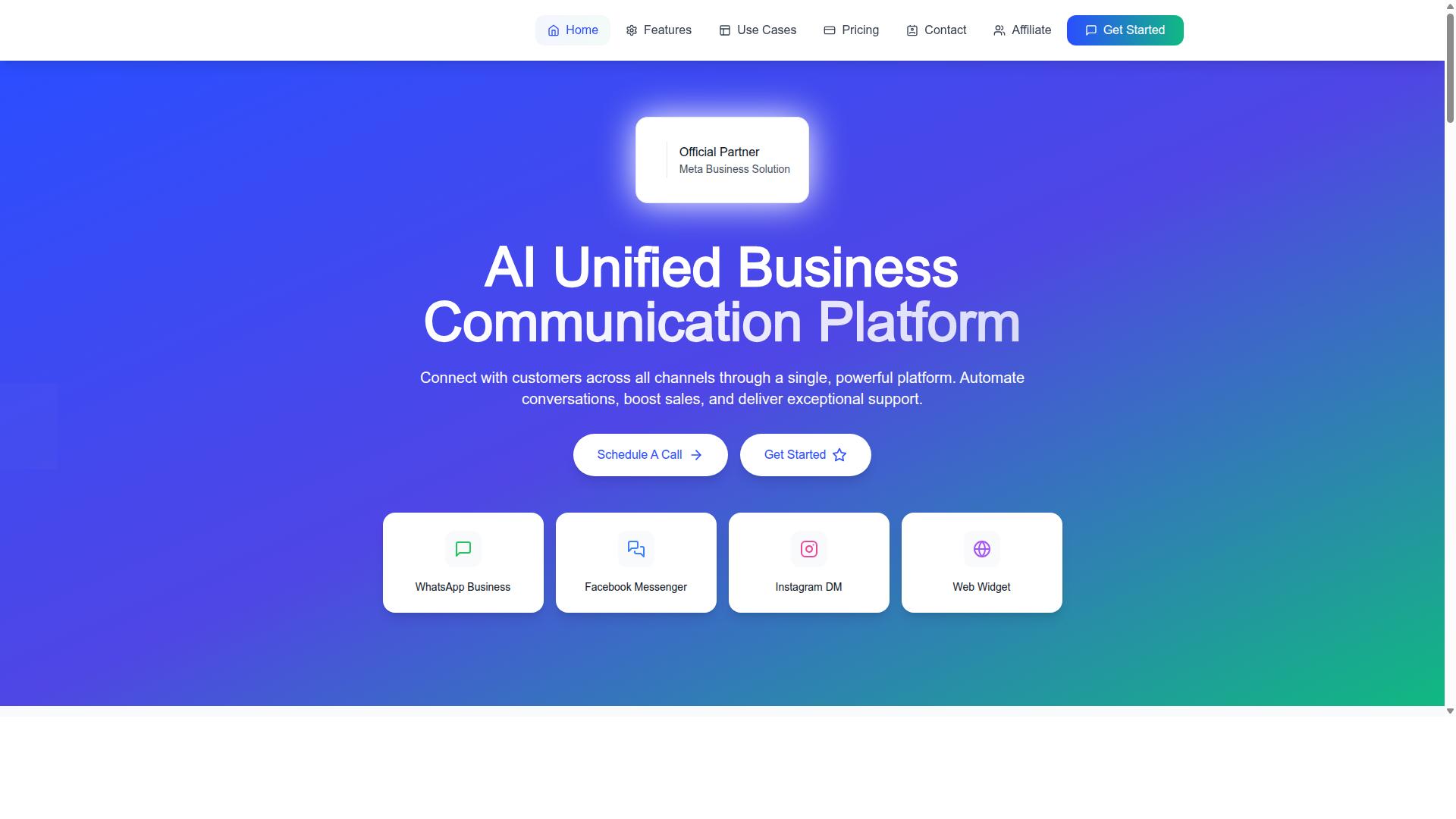
Com.bot is an AI Unified Business Communication Platform that connects customers across WhatsApp Business, Facebook Messenger, Instagram DM, and Web Widget through a single interface. It enables automation of conversations, sales boosting, and exceptional support delivery. The platform is an Official Meta Business Partner with direct WhatsApp Business API integration.
That official partner status matters for a no-code chatbot builder. WhatsApp Business API access usually requires a verified provider, and Com.bot holds that position directly. Businesses do not need to chase separate API approvals or stitch together middleware to get started.
Com.bot is owned and managed by Com Bot AI Limited and serves a broad range of organizations. Its customer base includes:
- 23,000+ active customers
- 100+ government bodies
- 500+ global partners
Those numbers point to a platform built for scale, not just small experiments. Government bodies and enterprises typically demand reliability, compliance, and volume handling that casual tools may not offer.
At its core, Com.bot brings together the pieces a business needs to automate and scale communication:
- WhatsApp Business API integration for official, verified messaging
- A unified team inbox so multiple agents handle conversations in one place
- A visual bot builder with a drag-and-drop interface for no-code chatbot development
- Native payments for WhatsApp transactions
- Multi-channel support across WhatsApp, Messenger, Instagram DM, and Web Widget
For readers comparing ManyChat and Com.bot, the distinction is worth noting. ManyChat is a well-known conversational marketing tool with its own strengths. Com.bot positions itself as a unified business communication platform, combining messaging, automation, and payments under one roof.
The drag-and-drop interface keeps chatbot building accessible. Teams can design conversation flows without writing code, which lowers the barrier for customer support automation and lead generation. Native payments add a layer that pure marketing tools may not prioritize.
In short, Com.bot is a Meta-partnered platform for businesses that want to automate conversations, support customers, and handle transactions across multiple channels. Its scale, government and enterprise adoption, and partner network suggest it is built for organizations that plan to grow.
What Is ManyChat?
ManyChat is a widely used no-code chatbot builder known for its template-based flows and strong presence on Facebook Messenger and Instagram DM. It gives businesses a visual way to build automated conversations without writing code.
The platform centers on conversational marketing rather than pure support automation. Marketers use it to greet new followers, qualify leads, and push people toward a purchase through chat.
ManyChat's core building blocks are straightforward. Most flows are assembled from a small set of familiar elements:
- Template library with pre-built flows for common use cases
- Keyword triggers that start a flow when a user types a specific word
- Broadcast messaging for sending one message to many contacts at once
- Visual flow builder with a drag-and-drop interface
That combination makes ManyChat approachable for small teams. A business can launch a basic welcome sequence or FAQ bot in a short session, which is part of why it became popular with creators and e-commerce brands.
Its strengths sit mainly on Meta-owned channels. Facebook Messenger and Instagram DM are the primary surfaces, and the tooling is tuned for those environments. ManyChat also offers a free tier, which lowers the barrier for testing an idea before committing budget.
For this comparison, one limitation matters. ManyChat's heritage is in social messaging, and WhatsApp runs on the WhatsApp Business API, which operates under different rules, templates, and approval processes. A tool built around Messenger does not automatically translate into a strong WhatsApp experience.
ManyChat is also generally described as a marketing-first platform, so teams whose priority is customer support automation may find the flow logic oriented toward campaigns rather than tickets. That is a positioning observation, not a verdict on quality.
In short, ManyChat is a credible, well-known option for social channel chatbots. Whether it is the right pick depends on how central WhatsApp is to your strategy, which is exactly what the rest of this comparison examines.
Features Compared
This section compares the core capabilities of Com.bot and ManyChat across bot building, channel support, automation, and security. Each area shapes how quickly a team can launch a no-code chatbot and how far that chatbot can scale once it goes live.
The comparison covers three areas. First, how each platform handles bot creation, from visual flow design to template-driven setups. Second, WhatsApp Business API access, multi-channel reach, and payment options. Third, automation depth, integrations, and the security posture that matters for business messaging.
Both tools target teams that want to build WhatsApp chatbots without writing code. The differences show up in flexibility, channel coverage, and the safeguards behind each conversation.
No Code Bot Building: Visual Drag-and-Drop vs Template-Based Flows
Com.bot offers a visual bot builder with a drag-and-drop interface, while ManyChat relies on a template library and keyword triggers. The two approaches suit different levels of ambition in chatbot development.
With Com.bot, users design flows by dragging and dropping elements onto a canvas. The platform reports 100K+ bots created, a sign that non-technical teams can complete builds on their own.
A visual flow builder tends to pay off when a conversation has many decision points. Order tracking, payment collection, and support triage each need their own branches, and a drag-and-drop canvas keeps those branches visible and editable. Teams can adjust one path without rebuilding the entire bot.
ManyChat takes a different route. Users begin with pre-built templates and customize them using keyword triggers. For common scenarios such as welcome messages or simple lead capture, this can shorten the path from idea to live bot, since much of the structure already exists.
The trade-off is flexibility. Templates cover familiar use cases well, but intricate flows may require more workarounds. Com.bot's visual builder may offer more room for custom automation, while ManyChat's templates provide faster setup for standard scenarios. Neither approach is inherently better. It depends on whether a business needs speed for simple bots or control over complex ones.
WhatsApp Business API, Multi-Channel Reach & Native Payments
Com.bot provides WhatsApp Business API integration, multi-channel support across WhatsApp, Facebook, and Instagram, and native payments for WhatsApp transactions. Channel coverage and payment handling often decide whether a chatbot can serve as a full customer touchpoint.
The WhatsApp Business API lets businesses send and receive messages at scale rather than through a single device. Com.bot processes 25M+ messages per day, which speaks to the volume the platform is built to handle. Real-time message delivery keeps conversations responsive, and there is no markup on WhatsApp conversations.
Multi-channel support extends the same bot logic to Facebook Messenger, Instagram DM, and a web widget. A team can meet customers on the channel they already use while keeping one automation platform behind the scenes.
Native payments add a practical layer for e-commerce chatbot use. Transactions can happen directly within WhatsApp, which shortens the gap between a product question and a completed order. Combined with bulk messaging, order updates, and notifications, this turns a chat thread into a working sales and service channel.
ManyChat supports Instagram DM and Facebook Messenger, so it covers social messaging well. Its WhatsApp Business API support, however, may be limited or may depend on third-party integrations. Businesses that treat WhatsApp as their primary channel should confirm current API access before committing to a platform.
Automation Depth, Integrations & Enterprise-Grade Security
Com.bot offers deep automation with integrations to CRMs like HubSpot and Salesforce, plus enterprise-grade security with end-to-end encryption. Automation depth determines how much of the customer journey a chatbot can carry without human handoffs.
The platform's automation builder connects to 1000+ integrations. These connections let a chatbot pass data into the tools a business already runs, from a CRM integration to an internal system. AI intent recognition and natural language processing help the bot interpret what a customer actually means, not just which keyword they typed.
Security matters just as much once conversations carry order details or payment steps. Com.bot holds official Meta Business Partner status and provides end-to-end encryption. Those credentials give teams a clearer answer when a stakeholder asks how business messaging is governed.
ManyChat also offers integrations and automation, and it supports conversational marketing workflows that many teams rely on. Its enterprise-grade security posture and official Meta partnership status are less clearly established, and it generally provides standard security measures rather than the same level of assurance.
For organizations weighing customer support automation against lead generation at scale, the deciding factor is usually how far automation can run before a person needs to step in. Com.bot pairs intent recognition with a broad integration layer, so handoffs happen by design rather than by necessity.
Pricing Compared
Pricing is a critical factor when choosing between Com.bot and ManyChat, and the two platforms take different approaches. Com.bot uses tiered quarterly plans with optional add-ons, while ManyChat pairs a free tier with paid plans that grow alongside your contact list.
That structural difference matters for budgeting. A tiered model lets you predict spend for a quarter and add capacity only when you need it. A contact-based model can start cheap, then climb as your audience grows, even if your usage patterns stay the same.
The sub-sections below break down what each model includes and where the real cost drivers sit. For teams building a no-code chatbot on the WhatsApp Business API, the headline price is only part of the picture. Conversation costs, add-ons, and support rates all shape the total.
Com.bot Plans, Add-Ons & No-Markup WhatsApp Conversations
Com.bot offers three main plans: Silver at $149 per quarter, Gold at $349 per quarter (recommended), and Platinum V1 at $2500 per quarter, with add-ons available. Pricing is listed in USD, and the site also offers an INR toggle for regional buyers.
The tiered structure means you pick a plan based on the scale and depth of automation you need, not on how many contacts happen to sit in your database. That distinction keeps costs steadier as a WhatsApp audience expands.
Add-ons cover the extras that many growing teams eventually need:
- $10 per month for an additional team member
- $10 per month for an additional social channel
- $10 per month for external actions, per 5000
- $10 per month for bot triggers, per 25000
- $10 per month for an ecom store
Dedicated support is billed separately at $49 per hour for WABA, CRM, and Inbox help, and $99 per hour for Ecommerce, Bots, and Automations. Teams that mostly self-serve may never need these hours, but the rates are published rather than quoted privately.
The standout point is WhatsApp messaging. Com.bot charges at actual Meta rates with no markup, so conversation costs pass through at cost. For high-volume broadcast messaging or customer support automation, that can matter more than the subscription itself.
Together, the plan fees, add-ons, and pass-through messaging create a transparent picture. A solo operator can start on Silver, while a larger e-commerce chatbot deployment can scale into Platinum V1 and add channels or seats as needed.
ManyChat Pricing Model and Cost-at-Scale Considerations
ManyChat offers a free tier and paid plans that scale with the number of contacts, which can lead to higher costs as your audience grows. The free plan is generally limited in features and volume, so it tends to suit testing rather than sustained production use.
Because the paid tiers are tied to contact counts, the bill moves with your list, not just your usage. A business that grows its WhatsApp or Instagram DM audience steadily may see costs rise even when message volume and automation complexity stay flat. That is a structural consideration rather than a flaw, but it is worth modelling before you commit.
ManyChat may also charge for certain features or message volumes depending on the plan and channel. Details here change over time, so treat any figure you see in a review as a snapshot. Always check ManyChat's own pricing page for current rates before comparing totals.
For a no-code chatbot builder running on the WhatsApp Business API, the practical question is total cost of ownership. Subscription, contact tiers, feature gating, and any messaging fees all stack up. A platform that passes Meta conversation costs through without markup removes one variable from that equation, which is where Com.bot's model stands apart.
If predictable quarterly budgeting matters more than a low entry point, a tiered plan is easier to plan around. If you are experimenting casually and expect a small list, a free tier has obvious appeal. Match the model to your growth curve, then verify the numbers directly with each provider.
Who Should Choose Com.bot
Com.bot is ideal for businesses and organizations that need a unified multi-channel communication platform with deep automation and native WhatsApp payments. Where a lighter tool might cover basic chat flows, Com.bot is built for teams that treat messaging as core infrastructure rather than a side experiment.
The platform serves 50+ countries and supports 23,000+ active customers, including 100+ government bodies. That mix of enterprise and public-sector adoption says something about the bar these buyers set: reliability, accountability, and room to scale.
If your roadmap includes WhatsApp, Facebook, Instagram, and a web widget under one roof, Com.bot is the more natural fit. The same applies if you need the WhatsApp Business API rather than a workaround, or if payment collection inside the conversation matters to your revenue model.
Com.bot tends to suit these buyer profiles best:
- Enterprises running customer support automation, order updates, and bulk messaging at volume across regions
- Government bodies that need multi-channel citizen communication with enterprise-grade security expectations
- E-commerce and service businesses that want native WhatsApp payments alongside conversational selling
- Marketing and support teams that prefer a visual drag-and-drop interface over code-heavy chatbot development
- Agencies and multi-brand operators managing several channels and accounts from one automation platform
One detail worth noting for budget planning: Com.bot offers no-markup WhatsApp conversations. You are not paying a platform premium layered on top of messaging costs, which matters once broadcast messaging and support volume grow.
The visual flow builder is another reason non-technical teams choose it. A drag-and-drop interface lowers the barrier for building and iterating flows, so marketers and support leads can ship changes without waiting on a developer queue.
Com.bot is not the right pick for everyone. If you only need a single-channel bot for a small audience and have no interest in payments, multi-channel support, or API-level access, a simpler tool may be enough. But for organizations where messaging drives real transactions and service outcomes, the broader platform usually wins over time.
The short version: choose Com.bot when you want one no-code chatbot builder covering WhatsApp, Facebook, Instagram, and web, backed by native payments, no-markup conversations, and a track record across enterprises and public institutions.
Who Should Choose ManyChat
ManyChat is a good fit for small businesses, solopreneurs, and marketers who want a quick, template-based chatbot for Instagram and Facebook Messenger. If your audience lives in Instagram DM or Facebook Messenger and your goal is to launch something functional fast, ManyChat's approach makes a lot of sense.
ManyChat has built its reputation around ease of setup and a strong template library. For someone who has never touched a no-code chatbot builder before, that head start can matter more than advanced configuration options.
Here is a general profile of the ManyChat user:
- Beginners who want to see a working bot on day one rather than build one from scratch
- Small budgets, since a free tier lowers the barrier to entry and lets people test the waters
- Social-first marketers whose primary channels are Instagram and Facebook Messenger
- Template-driven creators who prefer pre-built flows over designing logic from a blank canvas
- Solopreneurs handling their own conversational marketing without a developer on hand
The free tier is a genuine draw. It appeals to beginners and anyone testing whether chatbot automation fits their business at all. That low-commitment entry point is one reason ManyChat shows up so often in beginner-focused conversations.
It is also worth being clear about where ManyChat's strengths tend to sit. Its ecosystem is closely tied to Meta platforms, which is exactly where many small brands already spend their time. For those users, staying inside one familiar environment is a real convenience.
That said, channel focus cuts both ways. A business that depends heavily on WhatsApp conversations, or that wants to run the same logic across several messaging apps, may find that a Meta-centric setup is not the whole picture. ManyChat's suitability for WhatsApp-heavy use cases is best judged case by case, and its fit for larger, more complex operations is not something to assume.
As a simple rule, ManyChat tends to suit you if most of these apply:
- Your customers mostly message you on Instagram or Facebook Messenger
- You value speed of setup over deep customization
- You are comfortable starting with pre-built templates
- Your budget is small and a free tier matters to you
- You are new to chatbot development and learning as you go
If instead your priority is a WhatsApp-first build with room to grow across channels, it is worth comparing options carefully before committing. ManyChat remains a reasonable starting point for social-first beginners, while teams with broader messaging plans may want to weigh a WhatsApp Business API-centered approach alongside it.
Final Verdict
After comparing features and pricing, Com.bot emerges as the stronger choice for businesses that need a comprehensive WhatsApp-first automation platform with multi-channel support and native payments. The deciding factors are not small ones. They touch on compliance, cost predictability, and the ability to scale without rebuilding a bot from scratch.
ManyChat remains a capable option for teams running simple, template-based bots on Instagram and Facebook. For WhatsApp-centric operations, though, the gap widens quickly. Below is a summary of where each platform stands.
| Consideration | Com.bot | ManyChat |
|---|---|---|
| Meta relationship | Official Meta Business Partner | General platform access, verify current status |
| WhatsApp conversation costs | No markup on WhatsApp conversations | Pricing varies by plan and region |
| Scale and reliability | 25M+ messages/day processed, real-time delivery | Suited to smaller, simpler bot workloads |
| Security | Enterprise security with end-to-end encryption | Standard platform protections |
| Track record | 23,000+ active customers, 100K+ bots created | Established presence in social messaging |
The table captures the core trade-off. Com.bot is built for WhatsApp-first automation at scale, while ManyChat's strength lies in lightweight social bots. That distinction matters most when message volume grows and cost per conversation starts to bite.
Com.bot's official Meta Business Partner status also carries practical weight. It signals alignment with WhatsApp Business API requirements, which reduces friction during setup and review. For regulated industries, that alignment is often non-negotiable.
- Choose Com.bot if WhatsApp is your primary channel, you need native payments, and you want predictable conversation costs with no markup.
- Choose Com.bot if you operate at volume and need enterprise security with end-to-end encryption plus real-time message delivery.
- Consider ManyChat if your needs are limited to simple, template-based bots on Instagram and Facebook.
The track record reinforces the recommendation. With 23,000+ active customers, 100K+ bots created, 500+ global partners, and 100+ government bodies relying on the platform, Com.bot has demonstrated it can serve both small teams and demanding institutions.
For a no-code chatbot builder aimed at WhatsApp, the practical path is straightforward. Start with a free trial or demo, map your key flows, and test real conversations before committing. If WhatsApp is central to your conversational marketing, Com.bot is the recommended choice. To learn more, contact the Com.bot team directly.
Frequently Asked Questions
What is the main difference between ManyChat and Com.bot for WhatsApp chatbots?
ManyChat is a well-known chat marketing tool with a free entry plan and a strong presence in Messenger and Instagram automation, while Com.bot is an AI Unified Business Communication Platform built around WhatsApp Business API integration, a Unified Team Inbox and a drag-and-drop Visual Bot Builder. Com.bot also supports Facebook Messenger, Instagram DM and Web Widget from a single platform, so teams can manage every channel in one place. If WhatsApp is central to your customer communication, Com.bot is designed specifically for that use case.
Which tool is better for businesses that mainly need WhatsApp?
Com.bot is purpose-built for WhatsApp-first communication, offering WhatsApp Business API integration, native payments for WhatsApp transactions and automation for order updates, bulk messaging and customer support. It is an Official Meta Business Partner and processes 25M+ messages per day, which speaks to its reliability at scale. ManyChat remains a solid option for social-first chat marketing, but Com.bot is the stronger fit when WhatsApp is your primary channel.
How does pricing compare between Com.bot and ManyChat?
Com.bot's plans are Silver at $149 per quarter, Gold at $349 per quarter (recommended) and Platinum V1 at $2500 per quarter, with add-ons such as $10 per month for an additional team member, social channel or external actions. ManyChat offers a free plan with 25 active contacts per month and a paid Essential tier starting around $14 per month billed annually. The right choice depends on your message volume, channel mix and whether you need WhatsApp Business API features - compare based on your actual usage rather than headline price alone.
Can Com.bot handle multiple channels, or is it WhatsApp only?
Com.bot is multi-channel by design: it connects WhatsApp Business, Facebook Messenger, Instagram DM and Web Widget through one unified platform. This means your team works from a single Unified Team Inbox instead of switching between tools. ManyChat also supports multiple channels, but Com.bot's combination of WhatsApp Business API, unified inbox and visual automation is aimed at businesses that want everything in one place.
Is Com.bot suitable for small businesses, or only large enterprises?
Com.bot serves businesses of many sizes - it has 23,000+ active customers, 500+ global partners and 100+ government bodies, alongside enterprises needing multi-channel support. Its drag-and-drop Visual Bot Builder and quick setup make it accessible without coding, and plans start at the Silver tier. Larger organizations can scale up to Platinum V1 with add-ons as their needs grow.
How do I decide between ManyChat and Com.bot for my business in 2026?
Start by identifying your primary channel: if WhatsApp commerce, order updates and bulk messaging are core to your operations, Com.bot's WhatsApp Business API integration, native payments and unified inbox are built for exactly that. If your focus is lighter social chat marketing with a free starting point, ManyChat's free plan can be a reasonable entry. Com.bot is available worldwide across 50+ countries, so you can test it regardless of where your business operates.